Tuesday, December 7, 2010

Soalan Lazim Ditanya atau Frequently Asked Question (FAQ).

Saya kerapkali ditanya dengan banyak soalan-soalan oleh kawan-kawan dan saudaramara yang ingin tahu  tentang pekerjaan saya semasa dalam TUDM. Ini berlaku apabila bertemu semasa dalam majlis-majlis kenduri, semasa ziarah menziarah kawan dan saudaramara. Saya percaya kita semua tidak dapat elak daripada perkara seperti ini, hanya dengan berterus terang sahaja dapat kita menceritakan perkara-perkara yang sebenar walaupun mereka kurang yakin dengan cerita-cerita yang diberikan dan justeru itu saya mulakan dengan menulis "Blog" supaya kemunculan blog saya akan memberikan keyakinan diri mereka terhadap saya dan TUDM. Ini lah jenis-jenis soalan serta jawapan-jawapan yang dapat saya sampaikan.

S : Berapa lamakah anda berkidmat dalam TUDM(RMAF)?

J : Berkidmat selama dua puloh dua tahun (1970-1992).

S : Lepas bersara buat apa?

J : Dapat kerja sebagai "Pegawai Pentadbir" di sebuah syarikat swasta.

S : Betulkah orang kata askar selepas bersara hanya dapat kerja sebagai jaga(security guard),pemandu bas dan lori?    
     
J : Tidaklah semua mestinya begitu.

S: Bagaimana anda boleh dapat jawatan sebagai "Pegawai Pentadbir" tersebut?

J : Nasib saya dikatakan baik juga sebab ada mempunyai "Adv.Dip.Business and Administration.,UK."

S: Dalam blog anda, anda adalah seorang yang berpangkat "Pegawai Waran II" mengapa pula anda mempunyai banyak bidang profesion yang lain seperti logistik, airgunner, navigator, fotografi udara, dan lain-lain?

J : Itu memanglah perkara biasa dan ianya merupakan aset penting dalam TUDM dan keperibadian. 

S : Seronok jadi airgunner?

J : Profesion tersebut memanglah menjadi kebanggaan saya.

S : Pernahkah anda merasa takut semasa menjalankan tugas sebagai airgunner di udara?

J : Perasaan takut akan hilang apabila semangat untuk berjuang itu tinggi, lebih-lebih lagi dapat menggunakan senjata-senjata yang dipasang pada helicopter tersebut semasa menggempor.


Bersambung....pada 16 Dis,2010.


S : Mengapa anda tidak memohon menjadi pegawai TUDM?

J : Dulu pada tahun 1972 saya pernah memohon tetapi gagal walaupun saya menpunyai Cambridge School Certificate(OSC/MCE) 1968.

S : Mengapa tidak memohon lagi?

J : Ketika itu saya lebih selesa dengan pangkat yang sedia ada kerana ianya dalam sekim pencen.

S : Bukankah pegawai mempunyai sekim pencen?

J : Ya benar! pada pegawai yang bertauliah jangka tetap sahaja, dan bukan pada tauliah jangka pendek.

S : Bukankah ada sekim kenaikan lain-lain pangkat terus kepada pegawai?

J : Ada! memang tersebut dalam Akta Angkatan Tentera 1972 dulunya dikenali sebagai Malay Regiment Enactment(MRE) tetapi ianya tidak diperaktikan secara meluas oleh TUDM ketika itu.

S :  Mengapa begitu?

J : Kemungkinan peruntukan kenaikan pangkat secara terus terhad pada ketika itu jika dibandingkan dengan sekarang, di mana ramai lain-lain pangkat telah dinaikan terus ke pegawai. Kalau tidak silap saya ianya telah bermula secara meluas pada tahun1991 terutama sekali daripada bidang kejuruteraan dalam TUDM.

S :  Adakah anda merasa ketinggalan kerana tidak menjadi pegawai?

J : Tidak pula saya merasai sedemikian, dan jikalau saya menjadi pegawai, siapa pula nak jadi Pegawai Waran.

S : Mengapa anda masih berpaut kepada pangkat Pegawai Waran?

J : Pangkat Pegawai Waran adalah pencapaian pangkat yang tertinggi dalam kalangan lain-lain pangkat rendah dan ianya amat disegani oleh pegawai-pegawai atasan, serta berkebolehan dalam bidang profesionnya, berpengalaman, tahap displin dan mempunyai kepimpinan yang tinggi. Pegawai Waran merupakan "General of the other rank" yang selalu disegani dan dihormati oleh anak-anak buahnya.

S : Bagaimana hendak sampai kepada tahap pangkat Pegawai Waran dalam TUDM?

J : Dalam TUDM, selain daripada memperolehi kemahiran dan beberapa tahun pengalaman berkidmat, calon-calon untuk Pegawai Waran mestilah wajib lulus "Kursus Kaedah Mengajar", dan "Kursus Pegawai Waran" daripada Institut Teknologi Udara, Kinrara.


S :  Apakah detik yang paling pahit sekali semasa bertugas dengan TUDM?

J :  Semasa peristiwa terhempasnya sebuah pesawat Nuri di Sungai Lundu, Kuching, Sarawak pada 18 Dis, 1989 yang meragut nyawa kesemua 16 penumpang anggota tentera Malaysia termasuk Pegawai Pemerentah Div.ke2, Mej.Jen.Datuk Mustaffa Awang dan Pemerentah Brigade Infantry ke3, Brig.Jen.Datuk Hasbullah Yusoff, serta juruterbang dan anak-anak kapal...Al-Fatihah.


Monday, November 29, 2010

The Reconnaissance Squadron (No.11 Squadron RMAF Base Butterworth).

No.11 Sqn.crest 1983.


Founded on October 1969 with 10 x Avon CA-27 Sabre aircrafts and service was terminated on August 1975. Its Commanding Officers were Sqn.Leader Quek, S/Ldr.Jaafar, and S/Ldr.Zainuddin.

June 1983 the No.11 Sqn.was reactivated as a "Reconnaissance Squadron"  with 2 x RF5E aircrafts newly introduced into the RMAF with Mej(U) Bashir, as the officer in command, second in command Mej(U) Zakaria Salleh accompanied with several officers as  reconnaissance pilots, imagery interpreters were WO1 Mohd Isa, Flt.Sgt Mohd Ismail, Sgt.Hood and Sgt.Ghazali and the photo technical groups were Capt(U) Ganesh, Sgt Yeong, Cpl Abu, Cpl Serah Keri, Cpl Che Ani and the others. All reconnaissance activities were considered classified and was part and parcel of the RMAF intelligence. In 1993 showed the ending era after 10 years  of reconnaissance experiences. Probably by now...the airforce may be eyeing on an unmanned aerial vehicle(UAV) or remotely piloted vehicle (RPV). 
                       
  
  CA-27 Sabre aircraft displayed at ITU campus,Kinrara 1983.


RF5E aircraft 1983


Forward Oblique Camera Station(nose) 1983.


Sunday, November 14, 2010

Imagery Interpreters of the RMAF (1983-1989).

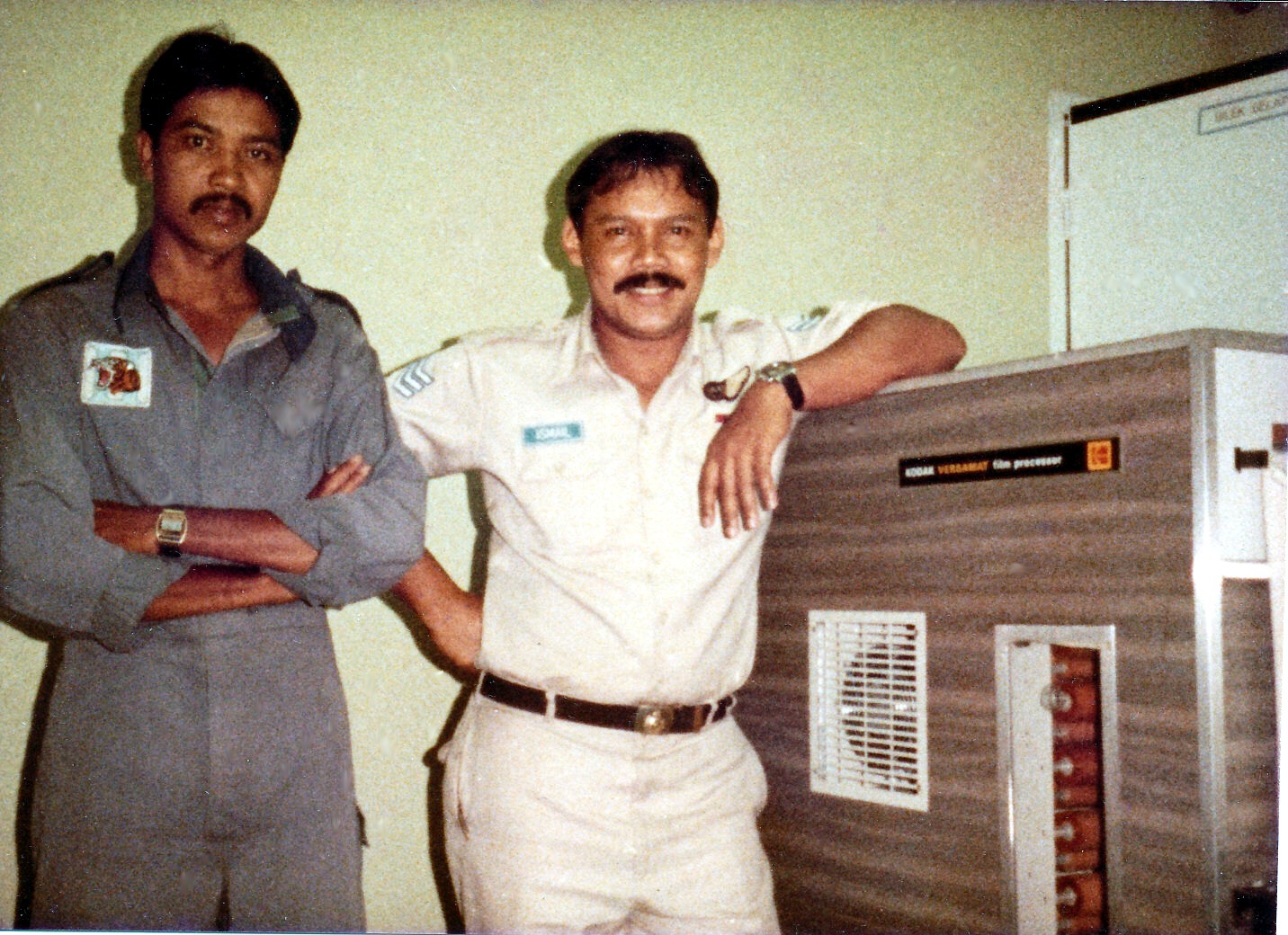
In June 1983, the newly reactivated No.11 Reconnaissance Squadron brought the first four RMAF operational imagery interpreters to date. They were WO1 Mohd Isa, Sgt Mohd Ismail(self), Sgt Hood and Sgt Radzali. The Imagery Interpreters or Photo Interpreters(PI) were the specialists and their jobs are to interpret films and photos taken  by the RF5E aircraft from specific targets on friendly or enemy locations. Black and white films and photos interpreted may be of an infrared-red or normal type. The evaluations and assimilations of films and photos were then reported to the requesters or higher authorities concerned with an uncountable classified duties performed day or night on base and deployment operations whenever required. I  had my first experienced occupying the back seat of the F5s as a 'Target Coordinator' and Capt(U) Halimin Pandi was my F5 pilot flying. In fact the four of us had the opportunity to fly with the F5s and as a PI, was just like an Alouette III gunner sitting at the rear seat, this time with no guns but two pairs of good eyes and navigation maps and it was authorised. 


The four US trained Imagery Interpreters
Sgt.Mohd Ismail(self), Sgt.Radzali, WO1 Mohd Isa, and Sgt.Hood.


RF5E flying for imagery target acquisitions


Camera's downloaded from RF5E aircraft.


The downloaded film cassettes were sent to No.11 Sqn.base laboratory for film processing.
From left to right: Cpl Che Ani-Lab.Technician, Sgt Mohd Ismail-PI(Self).

The base dark room for photo printing (Self).


Imagery Interpreter at the light table-evaluation and assimilation process with classified report sent out.
(Photo of self)

Imagery Interpreter may have to work in External Mobil Laboratory c/w Transporter.


External Mobile Laboratory on C130 aircraft for Labuan deployment 1985.
(Photo of self at far right : Wheel choking).

Labuan deployment 1985.


Sunday, October 24, 2010

Gunship Type of Targets

There are two types of gunship's targets:
  1. Training Targets.
  2. Operational Targets.
Training Targets: West Malaysia's enhancement training targets located at Song-Song  island catered for the live firing practices by the RMAF fighter aircrafts and the AlouetteIII gunships.

Operational Targets: 
  1. Sighted Target - are visible and confirmed targets, such as from an open ground. 
  2. Non-Sighted Target - are non visible targets, such as thick jungle canopy where ground surfaces are covered by shrubs and trees.
The operational gunship's mission along the Thai / Malaysian borders are mostly of a "Non-Sighted Target". This was due to the thick tropical jungle conopy bestowed. The firing power for this type of target required clear-cut informations from the troops on the ground regarding of their own friendly troop's position and the enemy whereabout. This was done during the pre-take off  "brief"  for the gunship's pilots/gunners and the Nuri pilots by the Commanding Officer(CO) or BASO(Brigade Air Support Officer) and the intelligence officer(IO) involved. Immediately after the "brief" or briefing the gunship airborned for the intended firing of the enemy location. After the gunship's firing and securing the areas, then only will make ways for the Nuri helicopters to move in for safer logistic resupplying(Resup), troop's move or change over.

Troop Move  Sibu, Sarawak 1983.

The recurring sorties of the Nuri helicopters flown to the same intended location the more likely for the enemy to retaliate. Therefore the AlouetteIII gunships has to keep "watch" from the air and counter firing may be necessarily carried out on orders from the ground control commanders. In hot areas, as much as several Nuris and two gunships escort helicopters be employed for one given tasking, and definitely would be an hectic and life-gambled day to accomplish the mission.


Friday, October 22, 2010

The Alouette III Gunship


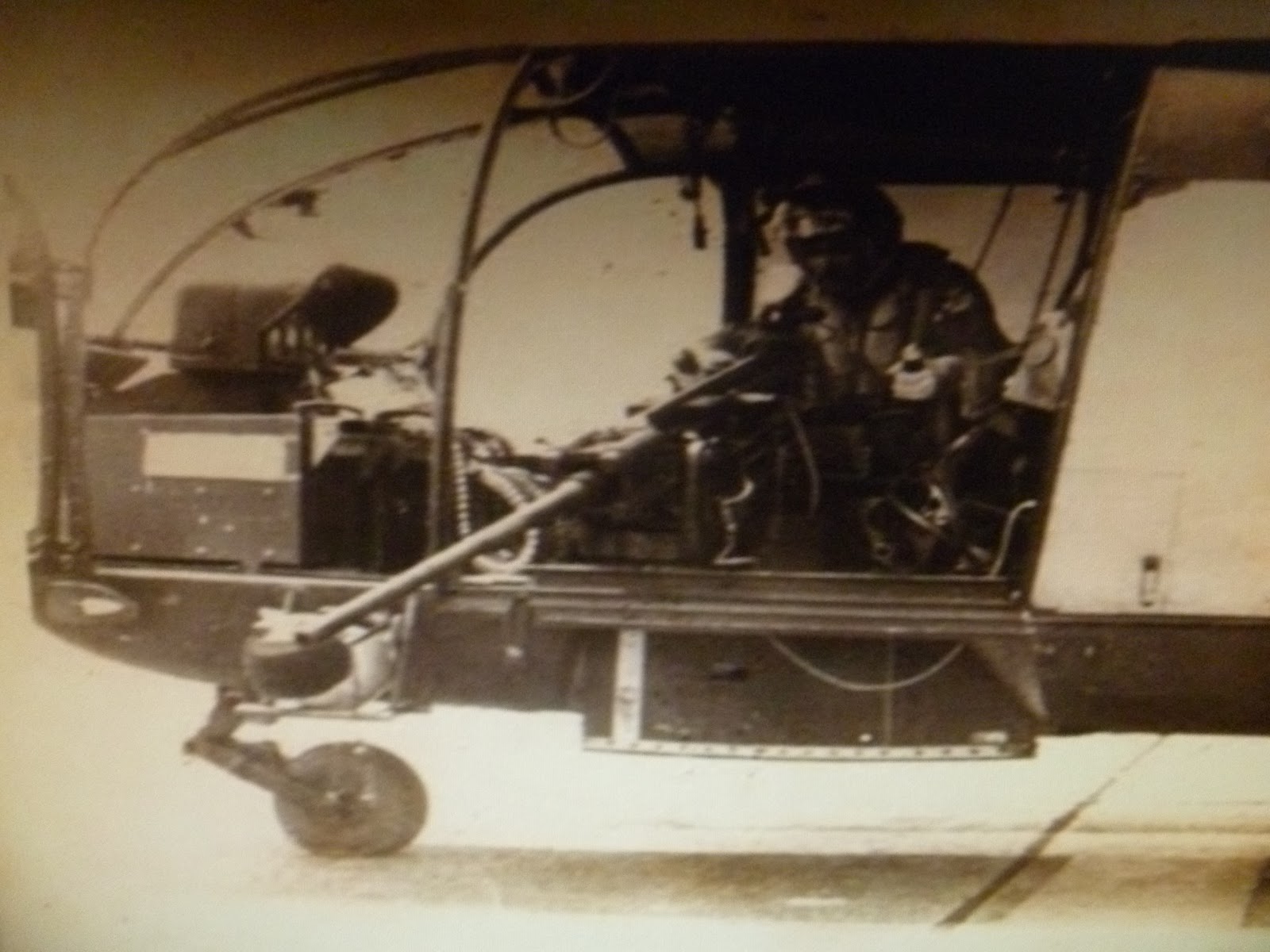
              RMAF AlouetteIII gunship equipped with 20mm Cannon MG151/20mm.

Alouette III first entered service of the RMAF in 1963 and  built by Sud Aviation Aerospatiale, France.This was the most powerful Alouette III gunship helicopter in the RMAF's inventory of the 70s. Powered by 870shp Turbomeca Artouste turboshaft, the SA316B cruises at 115 mph (185km/hr), while the SA319B cruises at about 120 mph (190km/hr). Its capability in changing to multi-roles that made it popular in many countries. The gunship role fitted with a single 20mm Cannon MG151 and supported by two ammo bins of 200 rounds of 20mm bullet in either ball(AP) or standard high explosive(HE) for each bin. HE is a bullet that will explode again on impact and has a killing radius of 10 feet. The ammo are link directly from the ammo bin to the cannon. The gunship has two crews, one a gunship pilot and the other, a qualified air-gunner.


Alouette III MG151/20mm Cannon - Photo found at www.militaryphotos.net

Data on the 20mm MG151(MG151/20).
Developed in 1941 used by the German's fighter bombers during the World War II, had a high muzzle velocity which makes for stable trajectory and high impact speed / longer range.

  • Manufacturer : Waffenfabrik Mauser AG, Germany.
  • Caliber          : 20mm (20 x 82 cartridge).
  • Weight          : 42 kg.
  • Barrel length  : 43 1/2 inches.
  • Barrel weight : 22 lbs 14 ounces.
  • Muzzle velocity : 800 m/s.
  • Rate of fire : 800 round/min.
  • Round types : Ball or armour piercing(AP), standard HE, and HE(M) "mine shot". 
  • Round weight: 117g(AP), 115g(HE), 92g HE(M).
  • Two version: Normal with percussion firing, and E-model with electrical priming.

      MG151/20 20mm Bullet (left of the golf ball).

      This escort gunship helicopter were used during the communist emergency between 1975-1980s and most were deployed in northern part of Malaysia including the Thailand/Malaysian borders. It has participated in many operation theatres such as "Operation Daoyai Musnah", "Operation Selamat Sawadee", "Operation Cahaya Bena", "Operation Gonzales" Ipoh, Perak, "Operation Jala Emas" Sungai Siput, Perak, "Operation Ukur" or "Ops Ukur", "Ops Kota Echo",and "Ops Sri Aman", Sarawak. After The Malayan Communist Party(MCP) founded 1930 finally laid down its arms in 1989, the  Alouette III helicopters were ceased down from its gunship operations and its now in the state of dormancy.

      The "Operations" had logged me the total of 1300 flying hours and of which 650 hours (50%) allocated for the gunship missions flown from 1977 - 1980 with the total firing of 3,528 rounds of balls and HEs recorded. It was a tough and rough for those era years of gunship flying compared to this present day, and somehow I've contributed to the fullest of my ability for the sake of religion, country and the future generation. I am hoping that the public will treasured, and understood for all the hardships that the RMAF and Malaysian Armed Forces personnels had sacrificed during the past emergency.


                       "Operation Selamat Sawadee" at Kroh Detachment Airfield 1978

      Photo:
      Lt(U) Yahaya,Lt(U)Johan,Kapt(U)Musa,Kapt(U)Raja Mohd,Col(U)Fauzi(CO RMAF B'woth),Kapt(U) Chong K.L,Mej(U)Stephen Ngiau(OC No3 Sqn.),SAR Crews.
      (Front row from left to right)
      Sjn(U)Mohd Ismail(self), Sjn(U) Mohd Baki, Kapt(U)Ismail.
      (Standing middle row from left to right wearing flying suits)
      No3 Sqn ground crews and SAR crews.
      (Standing last row)


      Tuesday, October 19, 2010

      Bagan Ajam, Butterworth Revisited.

      Bandar Sungai Petani,Kedah (Photo 2010).

      On the October 18, 2010 at time 1100 hours, I was driving from Sungai Petani to Bagan Ajam, Butterworth. As  I was passing by the RMAF Base main gate and proceeding straight for Bagan Ajam, I found out theres a lot of changes on both sides of the main road compared to fourty years ago. Theres new buildings erected and  roads built and some still under constructions and while road driving may add you with a little confusion.

      Approaching RMAF Base Butterworth's main gate (Photo 2010).

      Entrance to Bagan Ajam Residential (Photo 2010).

      Bagan Ajam Residential (Photo 2010).

      Bagan Ajam residential areas which at one time rented by the British and Australian personnels way back  in the 1960s to 1980s. Mr.Ramli my uncle, lived in these area too and bought his semi-detached house for around RM26,000 in 1966 and his neighbour was a British and they became good friends. I used to keep my uncle accompanied during the school holidays prior joining the RMAF in February, 1970. My uncle passed away somewhere in 1980s and several years later my aunt sold the house. It was a sad thing to experience and by the way I still remember and thanking them for bringing me up within the European environment.

      Gerai Makcik at Bagan Ajam (Photo 2010).

      Side view of Gerai Makcik (Photo 2010).

      On returning home, I stopped over at the "Makcik Stall". Today "Gerai Makcik" is still doing business for more than three decades despite Pakcik and Makcik has passed away and may God bless their souls. Now their sons and daughters continue running the business. Their nature of business is selling "Nasi ala Kampong" and of course hot and cold drinks available on request. Its airmen's favorite spot since 1970s and that included some Australian personnels too. I used to drop in for lunch with friends quite often here during my aircrewman days dated back in 1970s and the food were delicious.Well! I still visits the "Makcik Stall" for a drink whenever I am in Butterworth.

      PERNAMA Butterworth (Photo 2010).

      Not forgetting Butterworth's PERNAMA. As an ex-servicemen I used to shop for my household need at PERNAMA (Perwira Niaga Malaysia) formerly known as NAAFI (Navy,Army,AirForce Institute) whenever I am in Butterworth. I missed NAAFI  and somehow or rather it was not the product that matters but friendly environment that counts. Most of the NAAFI salepersons whom I knew years ago, must have already retired or left the services by now, except Mr Krishnan still known to be around. He was a young NAAFI saleperson when I knew him around 1977. Buying and window shopping at the NAAFI was a great thing to do. The good old NAAFI days.

      Taman Wira formerly known as Taman Tan Sai Gin (Photo 2010).

       Taman Robina formerly known as Robina Park (Photo 2010).


      Former Sheriff Stores closed (Photo 2010).

      Taman Robina October, 2010.

      Taman Robina October, 2010.

      Robina Park 1969 (Now Taman Robina).

      Passing by the Taman Wira(Taman Tan Sai Gin) and Taman Robina(Robina Park) once became the common residential areas for the British and Australian personnels in the 1960s until late1980s. Their children used to be seen cycling, strolling and happily playing within their house compounds and today they are all gone. The Aussies are not aliens to the Sheriff Stores as they knew him well, the main supplier of their household goods, newspapers, magazines, books and publications etc. While living at The Sergeant Mess in 1978, I used to cycle to his stores at Robina Park  in order to get hold of my latest copies of  foreign  magazines ordered such as  modern photography and Gun and Ammo. It was in 1980s where the Australians began leaving for homeward bound, Sheriff Stores businesses had to close down and later learnt that he had moved to Penang island. As a customer I missed the Sheriff Stores and coincidently with the Australian withdrawals signified the slowdown of other businesses around the Robina Park. It was a melancholic felt as I was about to leave Butterworth for Kuching, Sarawak in 1989, and those were the days and the memoir lingers on. 


      Friday, October 15, 2010

      Air Gunner's Weapon Inventories

      My shoulder holstered sidearm - Browning 9mm automatic pistol carried. 

      On every operational gunship mission, weapons are my best friends of which I am authorised. They were provided for my protection against the enemy and super-extended to safeguard the friendly troops below me with the superiority of cannon MG151 on-board the Alouette111 gunship. I use to carry three authorised weapons as an air gunner. Namely they are as follows: 

      Browning Automatic Pistol c/w 9mm bullets.


      Colt M16A1(retractable butt) c/w 2 magazines x 20 rounds of 5.56mm bullets.


      Cannon 20mm MG151 for Alouette III. Photo found on www.militaryphotos.net


      Additional gadgets bodily attached to me:
      1. 1x Dog-Tag or Name-Tag.
      2. 1x Identification Card (BAT.C 10).
      3. 1x Survival Knife.
      4. 1x Multi-purpose Pocket Knife.
      5. 1x Wrist-watch.
      6. 1x Binocular.
      7. 1x Pocket Compass.
      8. 1x Cigarette Gas Lighter.
      9. Edible Snacks.
      10. 1x Pocket-bottled 330ml filled with drinking water.
      11. 1x Flying Jacket.
      12. 1x Bullet-proof or Fragmentation Vest.
      13. 1x Mae West (Survival Jacket).
      A non-bodily attached Kits:
      1. 1x Night-stop Kit.
      2. 1x Survival Kit.
      3. 1x Pyro-technique Kit.
      FAQ
      Question: Besides handling the cannon MG151, do you have the opportunity to practice shooting with 9mm sidearm and the M16 rifle?
      Answer: Absolutely yes! and normally organised by the RMAF Base from time to time or it being requested by the Aircrew Wing independently.
      Question: Is there any shooting range at RMAF Butterworth?
      Answer: Yes! only a small shooting range which is suitable for small-arms like 9mm pistols. A larger shooting range are the Howard Camp Rifle Range, Sungai Petani which quite popular among NZAF, and the RAAF.Last but not least the Baghdad Rifle Range at 6 Bge.Camp Jalan Lapangan Terbang,Sungai Petani, Kedah.


      Self (left), Lt.M(U) Hamid (right) on shooting practices for M16 rifles and 9mm pistols.
      Baghdad Rifle Range at 6 Bge. Camp, Jalan Lapangan Terbang, Sungai Petani, Kedah (1978).